FFW | "YOUNG ENTREPRENEURS: THE CREATIVE AND COMMERCIAL PROCESSES OF LÍVIA CAMPOS, FOUNDER OF BEIRA"
By Guilherme Meneghetti
Fashion has always been latent in the life of Lívia Campos, 28, founder of carioca. Her maternal grandmother was a seamstress and patternmaker and an important figure to her, who grew up curiously observing her, always with admiration.
Observing this relationship with his grandmother, her father would say, "You're going to work in fashion!" She decided to go to college for Industrial Design, as objects had always fascinated her (especially the 1950s furniture her father collected), but in her college projects, Lívia always turned to fashion, and once she graduated, she realized it would be inevitable to work in the field.
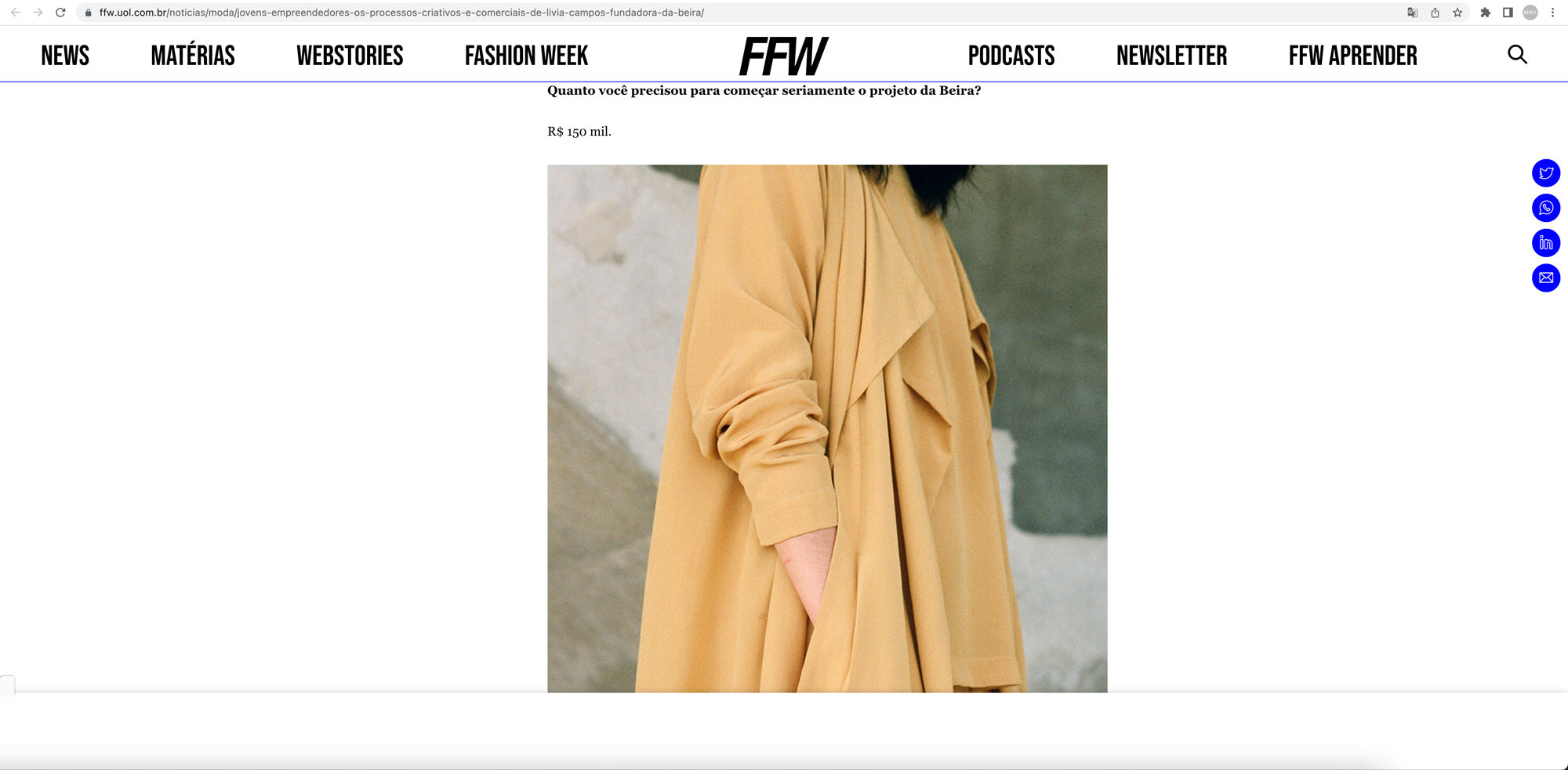
Thus, she created Beira in 2014. Monochromatic looks with ample cuts in fabrics like silk, cotton, and ecological silk form the brand's identity. Far from worrying about gender, her focus is on the inside of the garment, on cuts and details, evoking the functionality of clothes.
In a short time, she was already exhibiting her clothes at a fair in Paris. She herself kept showing up, taking risks, and even if she often felt insecure or afraid, she moved forward anyway: she exhibited in Berlin, Copenhagen, and New York. She has already paraded at Veste Rio and SPFW through the Estufa Project. Although she doesn't yet have an e-commerce or physical store, her pieces are found in multi-brand stores worldwide: São Paulo, Tokyo, Rønne (Denmark), Verona, and the list goes on.
Fun, witty, and dynamic, we talked to Lívia on the phone, and she told us how it all happened. Check it out:
— Did you always want to work in fashion?
That was a somewhat nebulous question for me. I always watched my grandmother sitting at the sewing machine, I thought it was very cool, I sort of idolized her – she was a very important figure to me. She died young, so I never got to learn to sew with her. However, all her daughters learned something about sewing; my mother knows how to sew, my aunt knows how to sew, everyone has this good memory of sewing. And I think because I liked her so much, going to her house, seeing the magazines and all that fashion stuff, my father would observe and say: "Oh, you're definitely going into fashion."
So I went to college for Industrial Design and throughout the course, I even made a "mini" brand with a friend, which led to us appearing in some fashion magazines – the Ela section, for example.
— Do you have fashion references, anyone in particular who inspires you?
I don't usually look at fashion itself. I look as a curious person and a consumer. I'm not the kind of person who knows what has been shown on the runway or not, what's trending or not. And maybe that's why I didn't like fashion much, being "in" fashion. I end up using clothes as a vehicle for some kind of communication, more personal really. I prefer to look at other types of objects for inspiration. I really like jewelry, I'm crazy about rings. I like to observe things that are very art deco, full of details and how difficult they are to make. I love observing that, it fascinates me more. But works that I think are super well resolved are by the Japanese Yohji Yamamoto, Issey Miyake, and Rei Kawakubo, who make wonderful folds, incredible things. I also really like some people who do something more organic and well-crafted, like Simone Rocha, who makes embroidered things, Faustine Steinmetz and her elaborate jeans – some of them are knits, beautiful. I think this manual intervention is wonderful. That inspires me. Not that I'm going to do it; what I do is completely different from that.
— When and how did Beira come about?
When I graduated, I thought the experiences I had would allow me to find a job quickly. But no. I also didn't want to go to São Paulo, where there are, in fact, more opportunities. There were only two brands I would have liked to work with, Lenny and Osklen. I even left my portfolio at the store, but never got a response – I even had an anxiety attack. After some time, I ended up meeting a former professor from PUC-Rio named Joana Pessoa. We then agreed to meet every week for her to advise me and for me to better understand which path to follow. Until fashion showed itself as the result. And then the Beira project started to emerge, I began to understand what was happening, the context, and identify where I could act according to the market, trends, and my universe: a clothing collection that would initially be focused on the male segment, also considering fabrics and patterns that would serve women, but further amplifying the catalog for men. Something simple and at the same time with details. These would not be clothes for an audacious man, who already circulates with feminine pieces, for example. The idea was to make them for someone more "conservative" so that a more "traditional" person could circulate risking lightly when dressing.
Along the way, I started taking patternmaking courses with a super cool Italian teacher. I discovered that I don't like patternmaking, even today, because it requires a lot of patience – and I don't have it – but, on the other hand, I lived in a studio that had complete infrastructure, where I could better understand what worked or didn't: the cutting tables, the machines, how the fabrics were exposed, how the threads were stored... I lived in that environment for a while, until my teacher returned to Italy. And that's when I had to look for a space to rent for a period of two months. I managed to set up a studio, which is where I am to this day. It was my Italian teacher, by the way, who recommended the patternmaker who works with me to this day, who also took the course and has the same way of thinking, which is why it has always worked out so well.
— How long did it take to build the brand and what was the initial investment?
It took almost a year. I looked for Joana at the end of 2013, she started guiding me in earnest in early 2014, and I launched the brand in August of that year. I also think it's very important to set yourself a deadline. The investment has always been very high and continues to be so.
— How much did you need to seriously start the Beira project?
R$ 150,000.
— Why “Beira”?
Before making the clothes, I needed a name for the website domain, label, all that bureaucracy. Observing the materials I was experimenting with as a language, I realized that a change in tone was where we saw the existence of the work itself, because otherwise it would just be a white paper or a beige paper. And then I came to the conclusion when observing when one thing is at the margin of another, the limit between one thing and another – this still makes a lot of sense to me. This place where we are on the verge of doing something, that's what I find very interesting.
We always focus on the construction of the piece, so that it is functional. For example, if two cuts are needed to make a blouse, it is in this cut that I want to intervene in some way. How can we think about creating a different blouse? The thought goes very much in that direction. The important thing for me is to see instead of thinking about creating something. What I can get from the shape in what I am seeing. I like to permeate two worlds. To be clean and exaggerated. Whether I want to or not, what I do during construction is also an exaggeration, why not? I don't like to know what is right or wrong, I prefer to stay in a middle ground, in a place where both possibilities coexist. On the verge of something.
— Who is your target audience?
I think that's the hardest question. Because, like, I think it's a type of mindset, above age, gender, and all those things. People who like Beira have different profiles. It's a more mature woman who will like looser clothing, that doesn't outline her body as much. Or the younger guy who wants to take a few risks when dressing. In other words, it's clothing that circulates in various environments. I can't say exactly, but it's definitely someone with a slightly more refined aesthetic eye, who likes comfort in their clothes, asks how it's made and where it comes from. I think there are common traits among people of different ages and genders.
— Beira's identity revolves around basic pieces with a focus on tailoring, featuring functional cuts and attention to detail on the inside of the garments. How did this preference arise?
I don't know. I encountered it, actually, it was an intuitive thing. A bit of what we talked about regarding the reason for the name "Beira," the power of doing various things and how to put that in its proper place.
If a piece doesn't have a cut, it will just be a fabric; that is, it's in the cut that the piece will have something special. The intervention, for me, is more interesting when it's in the cut, and having a function enchants me even more, because that way a meaning is attributed to it.
— Your looks never feature prints and are always monochromatic. Where did this preference come from?
I've never missed prints, it's rare to see a print that I actually think is cool. So from the beginning I went down this monochromatic path. I think prints are a very difficult job if you want to do something good, you know? But, look: I thought I would never do prints in my life and now I'm doing them for the next collection (Winter 18). So, everything has changed (laughs). Again, that's what I think is so wonderful about time, because at first I thought it had to be monochromatic forever, and nowadays, I'm putting a beautiful and wonderful print in the collection that is made with manual tying: the entire fabric is knitted and dyed with natural dye with vegetable extracts, then stretched in the sun... There's a super beautiful process behind all this, it's something I think adds a lot. The result was incredible.
Many people ask me to do prints, I decided to take a chance and I liked it! But it's just a small fabric too, nothing too much, the rest is all monochromatic.
— Natural fibers are common in your collections: most of the fabrics used are 100% silk or 100% cotton, and there's also ecological silk. How important is sustainability for you?
It's a topic that needs to be handled with great care. In general, I think everything new and growing already comes with this mindset, of knowing who made it, how long it took; there's no way not to associate it with production. The challenge is for large, established companies, which need to rethink their structure. I've been working more and more with hand-woven fabrics, dyeing with plant extracts, and reusing silkworm cocoons. The search for suppliers who work sustainably is constant. Furthermore, our customers are especially attentive to the issue of sustainability. Today I think about diversifying the materials I work with even more.
— Was it difficult to find ecological silk? Is it expensive to keep it in your production?
It was very hard to find. A friend of mine recommended it to me, and man, it's super expensive. Nobody buys much because of that, and whoever buys, buys very little. That's not what sells. When you buy it, you realize how expensive it is and you ask yourself, "why?". Even more so when you're small and want to invest in something like that.
It's expensive because it's made on a handloom, which is only 40 cm. A pair of pants, for example, I make with six meters of fabric – imagine the work? It's chaos! I think it's a very expensive fabric because few people are investing in it, too. But I believe that soon we will experience a turning point where we will be able to make this type of fabric more viable. Also, because, on the other hand, it's a fabric to die for, stunning, the most beautiful thing in the world. I'll keep trying, I think there's a space for it.
In this last collection, for example, where I used fabrics made from reused silkworm cocoons, we were selected by LNCC, an incredible multi-brand store in London, whose buyer who chose these pieces is from the Conscious department, focused on conscious consumption. Today, many multi-brand stores have this category, in addition to women's fashion, men's fashion, accessories, etc., there's a specific buyer for slow fashion.
— How many collections do you create per year?
Two: winter and summer.
— What is your production process like?
It's all in-house. We're in a studio in downtown Rio de Janeiro, in Botafogo. Everyone works together, all the seamstresses are involved in the process from creation to production, prototyping, orders, everything. Everyone is close, nobody does anything segmented. The cutting is in-house, the atmosphere is calm, the fabrics are from suppliers with very cool references – some have certificates, others don't, which is a separate issue.
— Shortly after starting your brand, you were already taking Beira to international fairs.
I did the first one when I won a competition right after I launched the brand, in 2014, to exhibit the clothes in Paris. It was a time to really experiment, make mistakes, know what the fair's profile was, think about where I would like to be or not, how to participate, how to send the clothes, how to sell, etc. It was an overview of a fair that doesn't quite match my profile. However, that's when I became less afraid to take risks alone, you know? All the others I went to alone and it just happened. I was terrified, but I went, and things started to happen. Once I was at a fair in Berlin and they called me to participate in another one in Copenhagen the following month. It was the fair that worked out best for me, because I sold my first collection to some really amazing stores, like the Henrik Vibskov Boutique. I visited the store and they put me next to clothes by Yohji Yamamoto and Issey Miyake. I wanted to die, I got all conceited, disgusted (laughs). I was overjoyed, it was wonderful, but there's real life, right, expectation versus reality, because I don't have a clientele there. And then I had to think: "skip a collection? Don't skip?". Things that make you mature. In general, what I find really cool about these fairs is that foreigners really encourage you, they look for that thing to be the first to find something different, new, and bet on it, that's why we had more opportunities abroad and it ended up working out. Now I miss it, because I don't go anymore, you can't travel so much, it's very tiring, plus you carry the clothes in your suitcase... anyway, it's complicated. Today we send the pieces through Vald Agency.
— Your brand has already walked in the Estufa Project, at SPFW N43. How do you feel about doing a fashion show?
Man, I had never thought about doing one, it's not something I pay much attention to, because I'm much more about seeing people in everyday life wearing my clothes rather than at a specific event. But I was very surprised! I loved participating in SPFW, I want to participate in all of them. I really enjoyed the experience. However, I believe there are other ways to show yourself. I don't know, put on a concert... There are other ways to draw people into your world besides a fashion show.
— Regarding brand promotion, in the age of Instagram, do you think it's more effective to invest in social media or appear in fashion magazine editorials, for example?
I want to be everywhere (laughs)! What you get most is being on social media, that's a fact. It's much easier to get closer to your audience, you have more freedom to show yourself however you want. To appear in a magazine, you need to have a more professional press, which I also think is great. They are different things. However, for example, your clothing might be in the styling of an editorial, but your piece is under the shirt, the coat, the pants... Well, that's useless then. The moment you find a stylist who truly likes your clothing and invests in it, then I think it starts to make more sense. So I think perhaps there should be a closer relationship between the stylist and the brand.
— Why doesn't Beira have e-commerce yet?
I don't want to rush my e-commerce, you know? It's going to take me a long time to build it because once it's live, there's nothing else to do. We're planning for this year. At first I thought May, but I'm feeling it will be impossible. So I'm considering it more for the second half of the year. And I also haven't thought about whether it will be a national e-commerce or just foreign. We thought about doing one based in Copenhagen to serve another audience, because if the clothes leave here, we only serve Brazil, since shipping there is expensive, and if we do it there, getting it here is expensive. Or do both at the same time. I don't know, we need to think about where our stock will be, whether we will have stock or not...
— Where can we find your pieces?
Dona Coisa (RJ), Choix, Pair and Void in São Paulo, and multi-brand stores in Tokyo (Casimir Pulaskiday and Hankyu), New York (Swords Smith, OAK, Henrik Vibskov Boutique), San Francisco (Voyager, Better for Living), Los Angeles (Dream Collective), Oregon (Stand up Comedy), Verona (Macondo), Senigallia (I Portoncino), Copenhagen (Henrik Vibskov Boutique) and Rønne (Gute Mensch).
— Do you ever consider opening a physical store?
Definitely. Before, I didn't think about it, but now I think it's important. Given how things are in Rio, I don't know if it would be ideal here. I initially thought about São Paulo, but that's also difficult. I don't know. My thinking is more fluid, you know. I think more about something outside the country, I don't see many barriers, because it's expensive everywhere and I prefer to be close to people who are more interested – and to find that place, I need another year, a year and a half, something like that. But I'm very curious to think about what the architecture, clothes racks, fitting rooms, those things will be like.
— What advice would you give to someone who wants to start a fashion business?
Time. Allow yourself the luxury of carefully outlining what you want in your project. There's no point in making a collection in a month because it's not the collection itself, whether it's right or not, but it's the project as a whole: for whom, how, through what, what's the focus. And that takes time, you can't know immediately. The things that take longer are the best. I think, at least, about six months to outline everything, also because the important thing isn't the first year, right? It's the sixth, seventh. It's how you sustain yourself, that's the most complicated part. We are warriors, in general. To give you an idea, I have to buy zippers from São Paulo, because there are none here in Rio.
— And what do you plan for the future?
E-commerce and expanding the team. I think it will be good to expand a bit, to have more people here. Nowadays, everyone does many things here, so we end up briefly going through some steps where we could focus better.
CREDITS
Styling: @liviacunhacampos
Photography: @rmeliga
Link: https://ffw.uol.com.br/noticias/moda/jovens-empreendedores-os-processos-criativos-e-comerciais-de-livia-campos-fundadora-da-beira